At RAISE, our primary focus is on building strong, long-term partnerships that create sustainable change. However, when promising local initiatives approach us with concrete opportunities for impact, we assess how we can contribute.
This was the case in the autumn of 2025, when Murhula Zigabe, founder and director of Briquette du Kivu, reached out to us. His social enterprise in Bukavu, eastern DR Congo, was struggling to maintain stable production despite growing demand for its eco-friendly fuel briquettes.
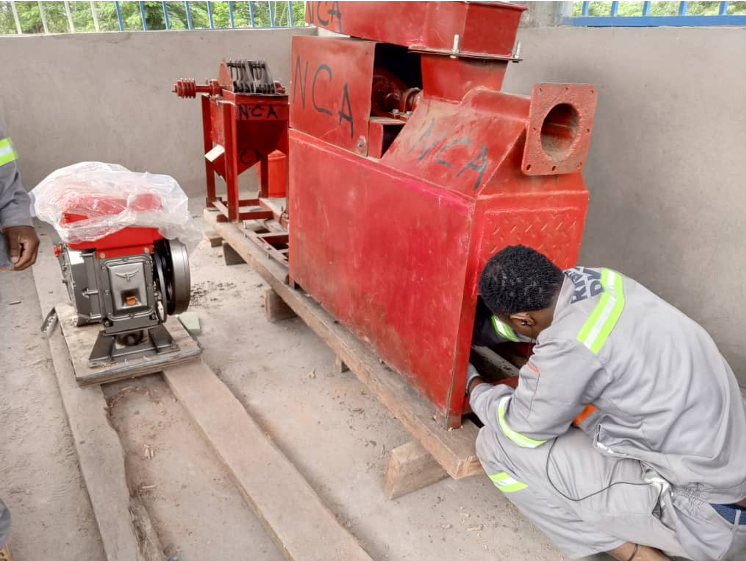
Briquette du Kivu produces clean charcoal briquettes made from by-products of insect farming – transforming waste into sustainable energy. However, outdated equipment limited production capacity. Murhula therefore sought support to acquire a modern briquette production machine from Kampala, Uganda.
Through dialogue with our local partners (MAMAH) in the insect-farming sector in Uganda, we helped explore the feasibility of the investment. In December, we were pleased to share that RAISE received DKK 29,000 in funding from the Novo Nordisk Honorary Fund to support the purchase and transport of the new machine.
The machine was purchased in February and became operational by mid-February. The impact was immediate.
Production has nearly tripled – increasing from 250 kg to 630 kg of clean charcoal briquettes per day, equivalent to approximately 15 tonnes per month.
This increase now enables Briquette du Kivu to fulfil its contract with Panzi Hospital, supplying four tons of briquettes. Panzi Hospital provides treatment and support to survivors of sexual violence in the region.
Increased Production – New Opportunities
The new production capacity has also required adjustments in operations and strategy.
To secure sufficient carbonised raw material for the machine, Briquette du Kivu is training vulnerable women in waste collection, drying, and carbonisation techniques. At the same time, five additional women are being recruited as local resellers to ensure that the increased production is effectively distributed within surrounding communities.
While Briquette du Kivu is not a formal long-term partner of RAISE, this initiative demonstrates how relatively modest support can unlock significant and scalable impact – strengthening sustainable energy production, local livelihoods, and community resilience.